
Katy Warner
Partner •
Brisbane

Transgrid has released a new Network Capacity Allocation Policy setting out criteria for when transmission capacity will be allocated for 'relevant large loads' which has significant legal and commercial implications for data centre proponents.
Transgrid has announced a Network Capacity Allocation Policy (NCA Policy) which outlines criteria for when transmission capacity will be allocated for 'relevant large loads'. The NCA Policy came into effect on 14 August 2026. Under the NCA Policy, for data centre developers seeking grid connections in constrained parts of the network, capacity will be allocated to projects that can demonstrate project readiness.
This article examines the NCA Policy and identifies the legal and commercial implications for data centre proponents.
Transgrid operates and manages the high voltage electricity transmission network in NSW and the ACT, connecting generators, distributors, and major end users such as data centres. NSW hosts more than 60 operating or under-construction data centres and a State Significant Development (SSD) pipeline of 20 projects valued at $51.4 billion. Investment in the State has grown at roughly 75% a year on average over the three years to December 2025.
According to a DCCEEW Consultation Paper released earlier this month, as at July 2026 data centres were seeking up to 28 GW of network capacity in NSW, with around 13 GW already in advanced connection discussions. By comparison, average daily electricity demand across NSW is typically only 7.5 to 10 GW.
Due to this high demand, Transgrid is presently handling a large number of applications for load connections to the Transgrid network, and capacity constraints are anticipated.
In circumstances where the prioritisation of one application for load connection may impact the capacity that is then available for other applications, Transgrid has an important role in ensuring that the network planning assumptions are managed in a consistent and transparent manner.
Consequently, Transgrid has introduced the NCA Policy to provide clarity on when and how transmission capacity available on its network is allocated to connection applicants.
Importantly, the policy does not apply to applications for access under the Electricity Infrastructure Investment Act 2020 (NSW), which the NSW Government is amending to enable the Energy Minister to establish access schemes for data centres of 15 MW or more.
The NCA Policy applies to inverter-based loads equal to or greater than 30MW or 30MVA, which are seeking to enter into a Network Connection Agreement (NCA) with Transgrid in one of two scenarios:
Scenario 1: prior to finalisation of performance standards for the load under Chapter 5 of the National Electricity Rules (Rules); or
Scenario 2: where performance standards for the load have been agreed in accordance with the process set out in Chapter 5 of the Rules (i.e. receipt of a 5.3.4A letter).
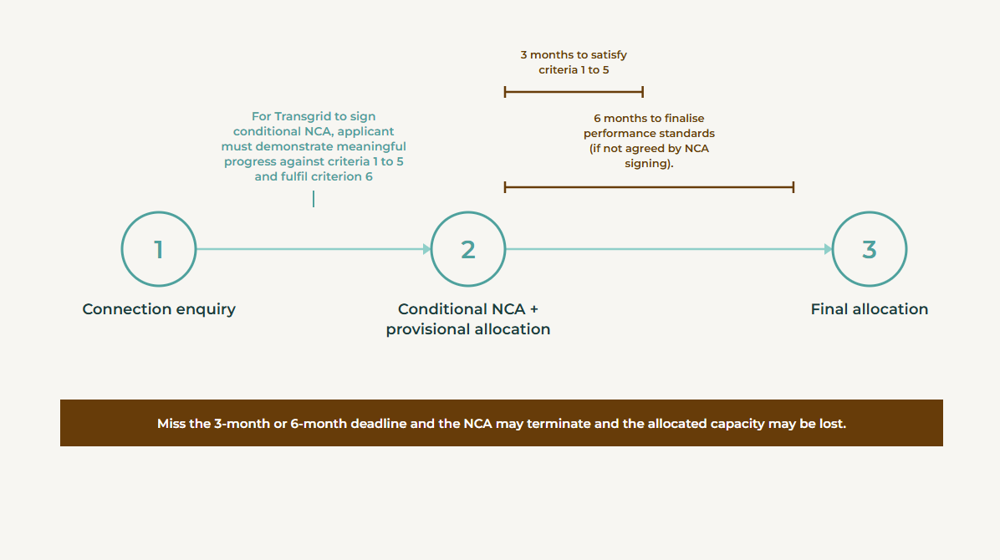
In respect of Scenario 1, Transgrid will enter into a 'conditional' NCA (an NCA in which performance standards are still outstanding and need to be finalised before the NCA is considered finalised under the NER) if proponents can demonstrate:
meaningful progress against criteria 1-5; and
fulfilment of criteria 6,
which are set out in the next section of this article.
In Scenario 1, the conditional NCA may be terminated if the proponent does not have performance standards accepted by AEMO and Transgrid within 6 months of execution.
In each scenario, the conditional NCA may be terminated if criteria 1 to 5 are not fully satisfied within 3 months of NCA execution. That is, network capacity is only provisionally allocated, and such allocation becomes final only if criteria 1 to 5 are fully satisfied within 3 months of NCA execution.
Where an NCA is terminated, the proponent loses its provisionally allocated capacity.
In deciding the allocation of capacity, Transgrid will take into account any augmentations to be funded by an applicant or any other committed augmentations.
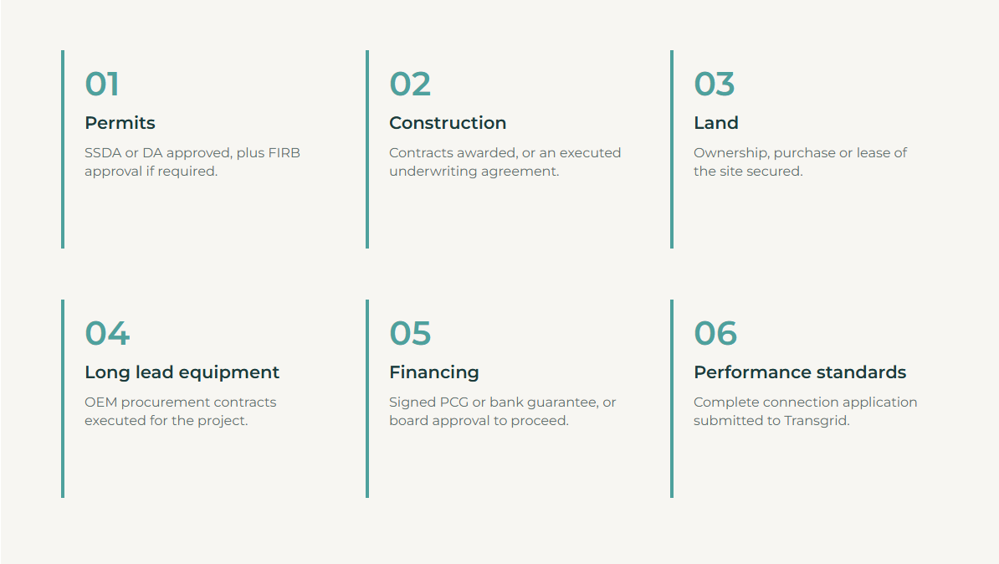
The six criteria against which Transgrid will assess a proponent's readiness for capacity allocation are:
Permits
There is an approved State Significant Development Application (SSDA) or Development Approval (DA), which can be seen in a NSW Planning Portal decision or through a similar source. That approval or a variation granted in relation to such approval, must have a load capacity which corresponds with the capacity agreed in the NCA. Additionally, if necessary, the proponent must have received its Foreign Investment Review Board (FIRB) approval.
Construction
Either:
a) construction contracts for data centre infrastructure work (which aligns with the capacity agreed in the NCA) that have been awarded; or
b) an executed underwriting agreement for early or preliminary works which has a data centre infrastructure work scope which aligns with the capacity agreed in the NCA.
Land
The proponent can demonstrate ownership / purchase / settlement / acquisition / lease of real estate property that is intended for the development of a facility commensurate with the capacity agreed in the NCA.
Long lead equipment
The proponent has entered into either:
a) major equipment procurement contracts with the OEM supplier(s) for the purpose of grid connection which are commensurate with the capacity agreed in the NCA; or
b) an executed underwriting agreement for early or preliminary works that covers major equipment for electrical/grid connection which aligns with the capacity agreed in the NCA.
Financing
The proponent has either:
a) a signed Parent Company Guarantee or Bank Guarantee for the purpose of developing the load facility which is commensurate with the capacity agreed in the NCA; or
b) Board approval for the proponent to proceed with developing the load facility which aligns with the capacity agreed in the NCA.
Performance standards
Transgrid has accepted for review a complete set of 'Connection Application' information which is consistent with the requirements of Chapter 5 of the Rules from the load proponent.
Criteria 1 to 5 are expressly aligned with the Cost Benefit Analysis (CBA) guidelines which the Australian Energy Regulator (AER) must prepare under clause 5.22.5A of the Rules and which AEMO must apply when preparing the Integrated System Plan (ISP). The same five criteria are used in the Regulatory Investment Test for Transmission which the AER must prepare under clause 5.15A.1 of the Rules.
In those contexts, the criteria were created to assess the commitment status of generation, storage and transmission projects for planning purposes in the ISP (and when carrying out the Regulatory Investment Test for Transmission). Projects may be classed as "committed", "anticipated" or "proposed". A committed project is one that meets all five criteria.
Transgrid's new policy carries several significant implications:
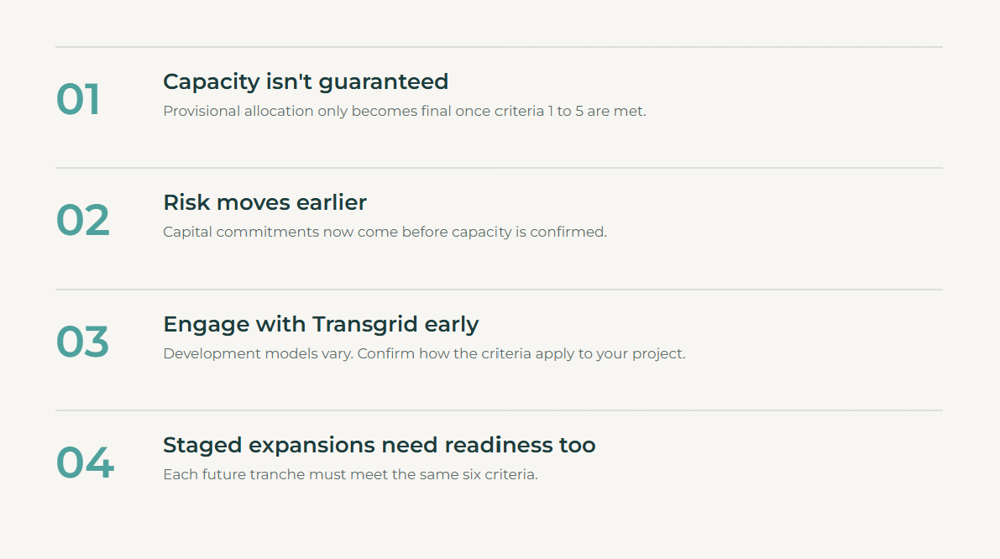
Capacity allocation is not guaranteed. Proponents should not assume that entering into an NCA secures capacity. As discussed above, capacity is only provisionally allocated when the NCA is signed. It becomes final only if the proponent has permits, construction agreements, land, equipment procurement, and financing fully in order within three months of executing an NCA.
The criteria front-load development risk. Satisfying the criteria may require material capital commitment (such as construction contracts, equipment procurement, and guarantees) before capacity is confirmed. This shifts risk earlier in the development cycle and may require developers to restructure their investment sequencing and approval processes. Some of this risk may be managed through NTP/conditions precedent regimes.
Early engagement with Transgrid is recommended. The criteria assume that the development status of a data centre project can be determined by reference to the same criteria as the development status of a generation, storage or transmission project. This may not be the case in practice, as there are multiple development models for data centres and some differ from those used for generation, storage or transmission projects. Proponents should consider engaging with Transgrid to understand how the criteria will be assessed for their specific projects.
The policy applies to current and future expansions. The readiness assessment applies not only to initial connections but also to potential future expansions of capacity at the same connection point. Developers with staged build-out plans must demonstrate readiness for each tranche.
The NCA Policy signals that Transgrid is finding a way to work through capacity issues by minimising capacity banking and rewarding project readiness.
For data centre developers, the message is clear: secure your permits, contracts, land, equipment and financing before you sign a connection agreement, or risk losing your place in the queue.
Legal updates and articles on the topics that matter to you, sent as they happen.
Subscribe