
Stuart MacGregor
Partner •
Brisbane

The EU’s Carbon Border Adjustment Mechanism (CBAM) entered its definitive phase on 1 January 2026, making embedded carbon now a direct cost for Australian companies doing business with Europe.[1] At the same time, Australia’s own Carbon Leakage Review (Review) has recommended introducing a domestic border carbon adjustment for select commodities, starting with cement and clinker and expanding to steel, aluminium, lime, hydrogen and ammonia.[2] For Australian exporters and importers in energy-intensive sectors, carbon tariffs are fast becoming an operational reality as energy transition programs advance across the world. This article provides a brief update on the CBAM and explores Australia’s current policy to protect its carbon intensive industries and keep them competitive in a changing global landscape increasingly subject to tariffs on foreign imports.
The EU CBAM is now operational, and Australian exporters face potential compliance obligations through their EU customers, with verified greenhouse gas emissions data becoming a competitive advantage.
The Review has recommended a phased domestic border carbon adjustment starting with cement and clinker, with implementation not expected before the 2026-27 Safeguard Mechanism review.
Industry is calling for carbon border protection as a prerequisite for investment in decarbonised manufacturing in Australia, with the Carbon Market Institute emphasising policy stability over wholesale reform.[3]
Contracts in carbon-exposed supply chains should be reviewed for carbon cost allocation, and businesses should build product-level greenhouse gas emissions verification capability now before it becomes a market access condition.
Whether Australian carbon costs under the Safeguard Mechanism will be creditable against CBAM liabilities remains uncertain, with the EU’s implementing regulation on third-country carbon prices still under development.
A CBAM imposes a charge on imported goods based on the carbon emissions embedded in their production. The purpose is to prevent “carbon leakage”, where emissions-intensive production shifts to jurisdictions with less stringent climate policies, undermining domestic decarbonisation efforts without reducing global emissions.
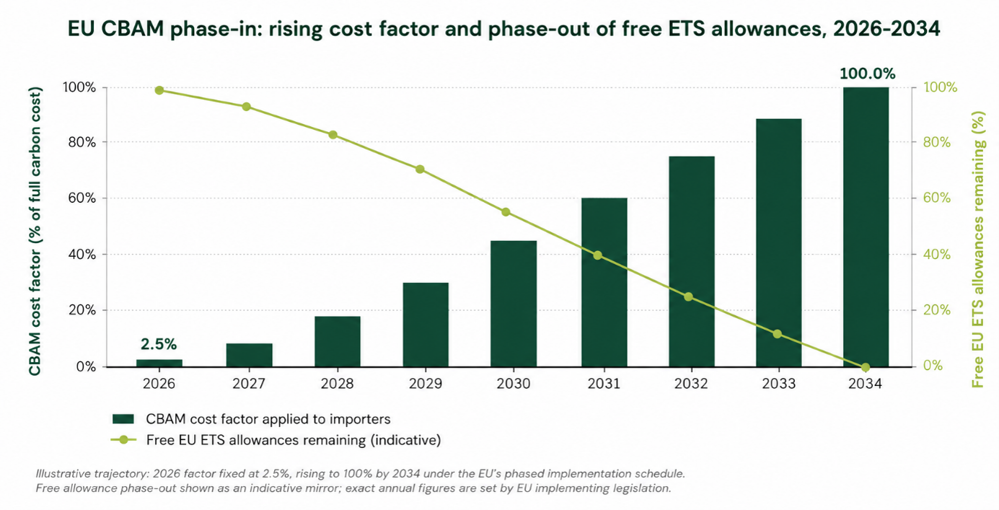
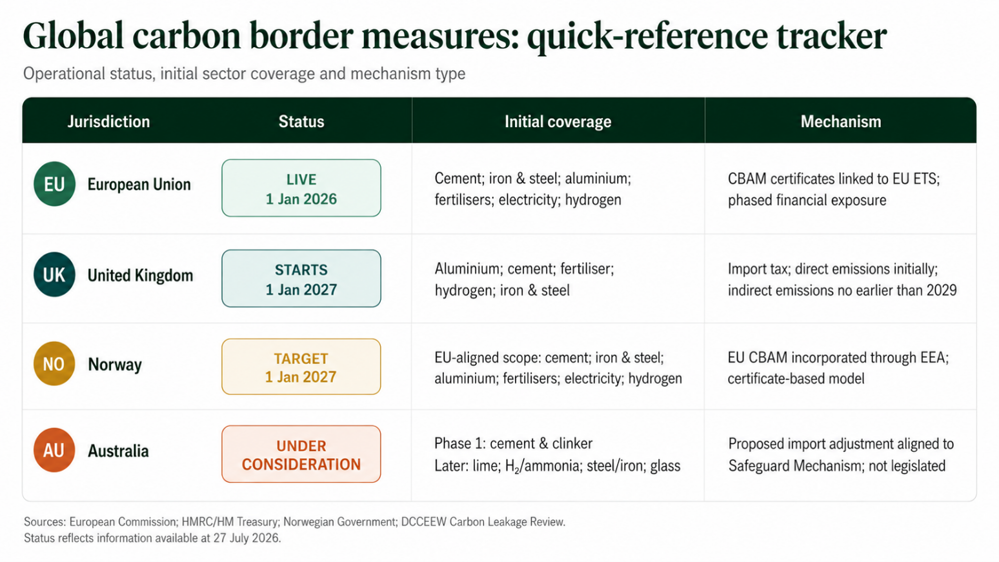
The EU CBAM currently applies to imports of cement, iron and steel, aluminium, fertilisers, electricity and hydrogen.[4] EU importers must purchase CBAM certificates at a price linked to the EU Emissions Trading System (ETS), with the first annual declaration and certificate surrender deadline falling on 30 September 2027 for imports made throughout 2026.[5] Importers can claim a deduction for any carbon price already paid in the country of origin.[6] In 2026, only 2.5% of the full carbon cost will be subject to the EU CBAM under the phased implementation schedule, rising annually (at different rates) to 100% by 2034.[7] From 2027, certificate pricing moves from quarterly to weekly averages, and the scope is expected to expand to at least 180 downstream products by 2028.[8]
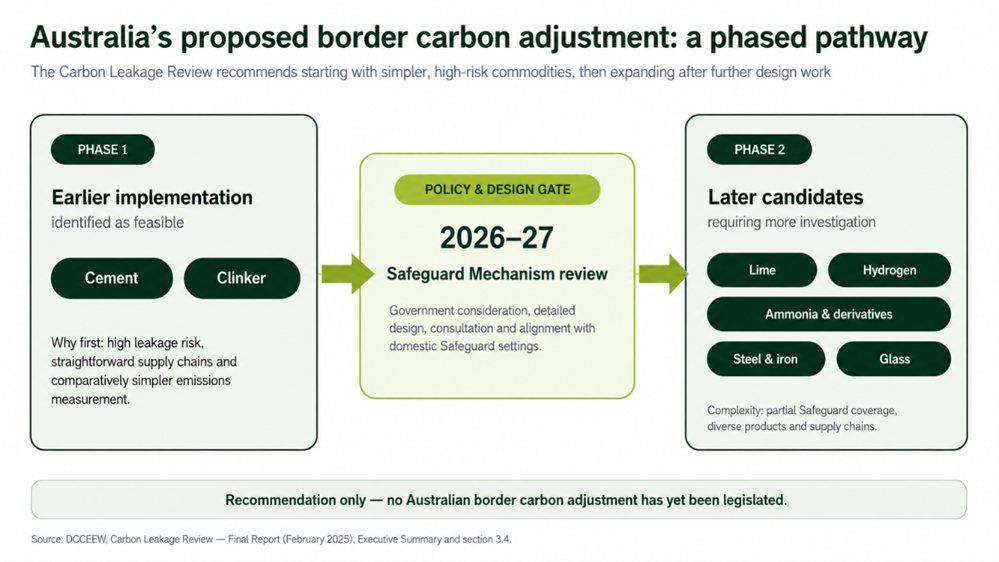
Australia’s Review, released on 13 February 2026 and led by Professor Frank Jotzo, recommended a phased approach to border carbon adjustment.[9] Cement and clinker were identified as initial priorities, with lime, hydrogen, ammonia and derivatives, steel, iron and glass recommended for a second phase.[10] The Review forms part of the Albanese government’s broader Safeguard Mechanism reform agenda, which sets declining emissions baselines for large industrial facilities through to 2030.[11] See our previous commentary on the Safeguard Mechanism reforms here and here.
The government has indicated it will consider the Review's recommendations as part of the 2026-27 Safeguard Mechanism review, suggesting implementation would not occur before that timeframe.[12] Notably, the recent Carbon Market Institute's August 2026 Safeguard Mechanism Symposium (CIM Symposium) emphasised the importance of policy stability and targeted recalibration rather than wholesale redesign.[13] The Review emphasised Australia’s opportunity to create a level playing field for traded emissions-intensive industry commodities and to help build an internationally interoperable system.[14] A domestic border carbon adjustment would, however, address only import competition. Most Australian facilities covered by the Safeguard Mechanism are export-focused, and for those industries, meaningful carbon border protection depends on the emergence of equivalent mechanisms in key Asian trading partners.
Jindal Steel International, an Indian manufacturing conglomerate with established low-carbon steelmaking operations in Oman, was shortlisted in May 2026 as one of the preferred bidders for the Whyalla steelworks.[15] The company has publicly stated that it is prepared to invest in the Whyalla steelworks to replicate its low-carbon iron and steelmaking operations, but the economics of green steel in Australia required policy support in the form of a tariff on imported high-carbon steel.[16]
The Jindal statement frames carbon border measures not as an environmental policy tool alone, but as an industrial policy prerequisite for private investment in decarbonised manufacturing.
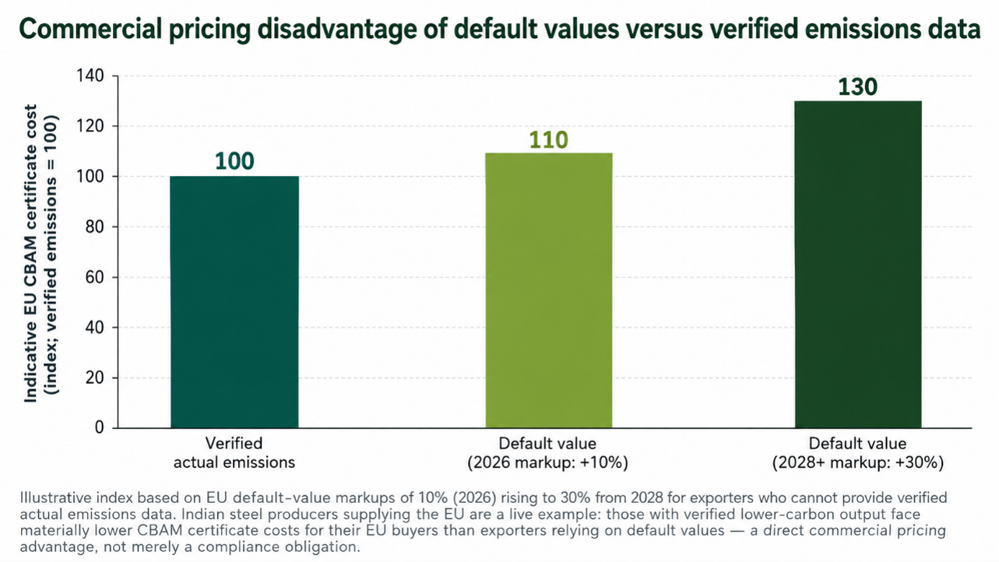
For Australian producers exporting to the EU, the CBAM creates a direct compliance obligation on their European customers. EU importers will require verified carbon emissions data from Australian producers to calculate their CBAM liability and, subject to the European Commission's recognition under the Article 9 implementing regulation, potentially claim deductions for carbon costs paid under Australia's Safeguard Mechanism.[17] Producers of iron, aluminium, steel, fertilisers and hydrogen who supply EU markets will need robust measurement, reporting and verification (MRV) systems capable of meeting EU methodological requirements.[18] Critically, exporters who cannot provide verified actual emissions data are subject to default values that include a penalty markup on top of the baseline emissions factor, 10% in 2026, rising to 30% from 2028, imposing materially higher CBAM costs on their EU buyers than producers with verified lower-carbon output.[19]
A recent study published in Nature Climate Change found early signs that the EU CBAM is already reshaping steel trade flows between the EU and India, suggesting that shifts in trade patterns may begin before exporters face the full financial costs of compliance.[20] Australian producers should expect similar scrutiny from EU buyers and should treat CBAM readiness as a competitive advantage rather than merely a compliance burden.
The WTO compatibility of CBAMs remains contested.[21] The EU has designed its mechanism with reference to GATT Article XX (general exceptions), which permits trade-restrictive measures that are “necessary to protect human, animal or plant life or health” or “relating to the conservation of exhaustible natural resources.”[22] The EU’s emphasis on actual emissions data, the availability of deductions for carbon prices paid in the country of origin, and the alignment with ETS pricing are all designed to strengthen its Article XX defence.
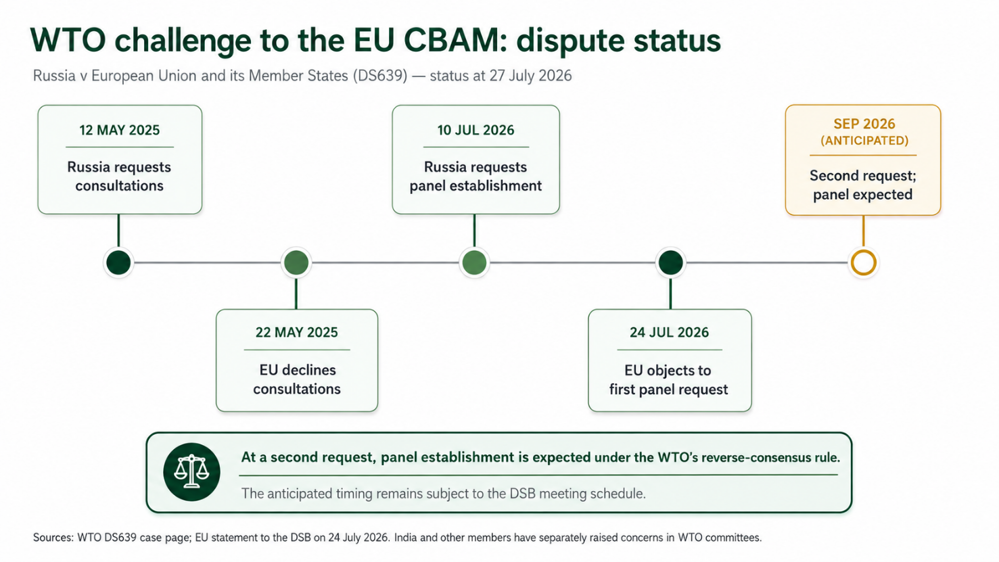
However, challenges remain. The mechanism’s interaction with the most-favoured-nation (MFN) principle under Article I GATT, the potential for de facto discrimination against developing economies, and the absence of recognition for non-price climate policies (such as renewable energy mandates) all present points of vulnerability.[23] Russia filed a request for WTO consultations on 12 May 2025 and subsequently sought establishment of a formal dispute panel; the EU blocked Russia’s first panel request on 24 July 2026, but under WTO procedures a second consecutive request cannot be blocked, meaning a panel is expected to be automatically established at the next Dispute Settlement Body meeting in September 2026.[24] India and several other members have also signalled concern at WTO committee level.[25] For Australia, any future domestic carbon border mechanism will need to comply with international trade rules, in particular, the requirement to treat imported goods no less favourably than equivalent domestic goods, and to ensure that any trade restriction is genuinely directed at an environmental objective rather than disguised economic protectionism.[26]
For Australian businesses operating in carbon-exposed supply chains, several practical considerations warrant attention now:
Carbon cost pass-through. Existing supply and offtake agreements should be reviewed for exposure to carbon border costs. Contracts that do not allocate responsibility for CBAM certificate costs, or that lack mechanisms for passing through carbon cost increases, may leave parties exposed to unbudgeted liabilities. New contracts should include express carbon cost allocation provisions, change-in-law clauses, and pricing review mechanisms that respond to evolving carbon policy.
Supply chain emissions data. EU importers will increasingly require verified, installation-level emissions data from their suppliers. Under CBAM, this data must be calculated according to the EU's own methodology (Implementing Regulation (EU) 2025/2547), which requires product-specific embedded emissions expressed as tCO₂e per tonne of goods, a different framework from the corporate-level GHG Protocol inventory. Australian producers and intermediaries should ensure their measurement, reporting and verification systems can meet EU methodological requirements now, before contractual requirements from EU customers crystallise into market access conditions. While Australia's mandatory climate reporting regime under AASB S2 (which commenced for Group 1 entities in 2025 and requires Scope 3 disclosure from the second reporting year) builds familiarity with emissions accounting, the CBAM obligation is installation- and product-specific rather than entity-wide, and requires separate, EU-accredited verification.[27] For further detail on the relationship between NGERS, the Safeguard Mechanism and mandatory climate reporting obligations, see our ASIC guidance commentary here.
Safeguard Mechanism interaction. Whether carbon costs incurred under Australia's Safeguard Mechanism (through surrender of Australian Carbon Credit Units or Safeguard Mechanism Credits) will be creditable against CBAM liabilities remains to be determined. Under Article 9 of Regulation (EU) 2023/956, a deduction is available only where a "carbon price" has been "effectively paid" under a qualifying "carbon emissions reduction scheme", defined narrowly as a tax, levy, fee or emission allowances under an emissions trading system.[28] The Safeguard Mechanism does not operate as a conventional ETS or carbon tax, and its recognition will depend on how the European Commission classifies it under the implementing regulation. The EU’s implementing act on carbon prices paid in third countries was subject to public consultation in May 2026. The outcome will determine whether and how Australian carbon costs are recognised, and this is a critical variable for exporters. A key message that emerged from the CIM Symposium was that both ACCUs and on-site abatement are necessarily complementary components of Australia's emissions reduction framework.[29] It should also be noted that the European Parliament removed the European Commission’s proposal to allow international carbon credits (Article 6 mechanisms) to be used to offset CBAM liabilities in July 2026, deferring that issue to the EU ETS review.[30] This narrows the pathways by which ACCUs might be recognised against EU CBAM obligations.
Procurement and investment decisions. For businesses procuring carbon-intensive inputs or evaluating investments in emissions-intensive industries, the direction of policy is clear. Carbon border measures will progressively level the playing field between high-carbon imports and domestically produced lower-carbon alternatives. Investment decisions, particularly in steel, aluminium, cement, lime and hydrogen, should be stress-tested against a scenario in which some form of Australian border carbon adjustment is in place within the next three to five years.
Carbon border measures represent a structural shift in the relationship between trade policy and climate policy. The EU’s CBAM is now operational. The UK and Norway will both follow in 2027, though the UK mechanism differs from the EU model in important respects: it operates as a tax rather than a certificate system, does not cover electricity, and delays coverage of indirect emissions until 2029 at the earliest. The EU and UK are also exploring linking their respective emissions trading systems, which could in time alter how Australian exporters engage with both markets.[31] Australia’s own review has recommended a phased domestic equivalent. And domestic industry, as the Jindal statement demonstrates, is actively calling for it.[32]
For Australian businesses in energy, resources and other emissions-intensive industries, the practical implications are immediate: review contracts for carbon cost exposure, invest in product-level emissions data and EU-accredited verification capability (noting that while NGERS already captures facility-level Scope 1 and Scope 2 data, CBAM requires that data to be attributed to individual products under the EU's own methodology and independently verified by a CBAM-accredited verifier), and plan on the basis that carbon will be priced at the border within the medium term.[34] The European Commission's proposal to reform the EU ETS for the period 2031 to 2040, tabled in July 2026 and including a proposed EUR 100 billion Industrial Decarbonisation Bank, will shape the long-term carbon price trajectory underpinning CBAM certificate costs, adding further reason to build flexibility into carbon cost forecasts beyond 2030.[35]
Lastly, Australia is also now one of the global leaders in implementing mandatory climate-related financial disclosures (in accordance with AASB S2, aligned with the ISSB's IFRS S2). Any existing or potential investors, lenders or creditors will be closely looking at the annual mandatory sustainability report lodged with ASIC to assess progress and the exposure of the industry to climate-related risks or opportunities including, from the second reporting year, Scope 3 value chain emissions.[36] For Group 1 entities (those with consolidated revenue of $500 million or more, or NGER reporting obligations above the section 13(1)(a) threshold), the first sustainability reports were due in 2026. Group 2 entities commence reporting from July 2026 and Group 3 from July 2027. Directors face personal liability risks if disclosures are not robustly verified, and ASIC has signalled it will use its new statutory directions powers to scrutinise climate statements. For further detail on the mandatory reporting regime, see some of our previous commentary here.
[1] https://taxation-customs.ec.europa.eu/carbon-border-adjustment-mechanism_en ; https://icapcarbonaction.com/en/news/eu-cbam-enters-compliance-phase-and-outlines-path-ahead ; https://kpmg.com/xx/en/our-insights/esg/carbon-border-adjustment-mechanism-cbam.html Back to article
[2] https://carbonmarketinstitute.org/2026/08/13/safeguard-symposium-key-takeaways Back to article
[3] https://www.dcceew.gov.au/climate-change/emissions-reduction/review-carbon-leakage; https://www.spglobal.com/energy/en/news-research/latest-news/energy-transition/021326-australias-final-carbon-leakage-review-recommends-cbam-like-scheme-for-high-risk-sectors. Back to article
[4] https://taxation-customs.ec.europa.eu/carbon-border-adjustment-mechanism_en ; https://www.pwc.nl/en/insights-and-publications/tax-news/other/ec-proposes-cbam-expansion-to-180-downstream-products.html Back to article
[5] https://taxation-customs.ec.europa.eu/carbon-border-adjustment-mechanism_en; https://kpmg.com/xx/en/our-insights/esg/carbon-border-adjustment-mechanism-cbam.html; Back to article
[6] Regulation (EU) 2023/956, Article 9; European Commission, Taxation and Customs Union, Carbon Border Adjustment Mechanism https://taxation-customs.ec.europa.eu/carbon-border-adjustment-mechanism_en. Back to article
[7] Directive 2003/87/EC (as amended), Article 10a(1a); Belgian Federal Public Service for Climate, Gradual CBAM Phase-In https://climat.be/cbam-en/cbam-certificates/gradual-cbam-phase-in. Back to article
[8] Commission Implementing Regulation (EU) 2025/2548 (methodology for CBAM certificate price calculation); European Commission, Taxation and Customs Union, Price of CBAM Certificates https://taxation-customs.ec.europa.eu/carbon-border-adjustment-mechanism/price-cbam-certificates_en. Back to article
[9] https://www.dcceew.gov.au/climate-change/emissions-reduction/review-carbon-leakage; https://apo.org.au/node/333551; https://www.spglobal.com/energy/en/news-research/latest-news/energy-transition/021326-australias-final-carbon-leakage-review-recommends-cbam-like-scheme-for-high-risk-sectors Back to article
[10] https://www.dcceew.gov.au/climate-change/publications/carbon-leakage-review; https://www.pwc.com.au/tax/tax-alerts/final-report-from-the-australian-carbon-leakage-review.html Back to article
[11] https://www.spglobal.com/energy/en/news-research/latest-news/energy-transition/021326-australias-final-carbon-leakage-review-recommends-cbam-like-scheme-for-high-risk-sectors; https://www.dcceew.gov.au/climate-change/emissions-reporting/national-greenhouse-energy-reporting-scheme/safeguard-mechanism; https://cer.gov.au/schemes/safeguard-mechanism Back to article
[12] https://www.dcceew.gov.au/climate-change/emissions-reduction/review-carbon-leakage; https://www.spglobal.com/energy/en/news-research/latest-news/energy-transition/021326-australias-final-carbon-leakage-review-recommends-cbam-like-scheme-for-high-risk-sectors; https://cbamguide.com/countries/australia/ Back to article
[13] https://carbonmarketinstitute.org/2026/08/13/safeguard-symposium-key-takeaways/ Back to article
[14] https://www.spglobal.com/energy/en/news-research/latest-news/energy-transition/021326-australias-final-carbon-leakage-review-recommends-cbam-like-scheme-for-high-risk-sectors Back to article
[15] https://www.aist.org/two-bidders-remain-for-whyalla-steelworks Back to article
[16] https://www.afr.com/companies/manufacturing/indian-giant-jindal-makes-its-case-for-whyalla-and-for-carbon-tariffs-20260721-p60h8k Back to article
[17] Regulation (EU) 2023/956, Article 9 (carbon price paid in a third country); European Commission, Draft Implementing Regulation on methodology for deducting carbon prices paid in third countries, May 2026 (consultation closed 10 June 2026) https://taxation-customs.ec.europa.eu/carbon-border-adjustment-mechanism_en. Back to article
[18] Regulation (EU) 2023/956, Article 7(7) (use of default values) and Article 8 (verification requirements); Commission Implementing Regulation (EU) 2025/2621 (default emission values for the definitive regime); O'Melveny & Myers, "How the EU's New Default Emissions Values Under CBAM Impact US Exporters", 12 January 2026 https://www.omm.com/insights/alerts-publications/how-the-eu-s-new-default-emissions-values-under-cbam-impact-us-exporters-what-you-need-to-know-for-2026/; International Carbon Action Partnership, "EU CBAM enters compliance phase and outlines path ahead" https://icapcarbonaction.com/en/news/eu-cbam-enters-compliance-phase-and-outlines-path-ahead. Back to article
[19] Commission Implementing Regulation (EU) 2025/2621 of 31 December 2025, laying down default values of embedded emissions for CBAM goods under the definitive regime (OJ L, 2025/2621); International Carbon Action Partnership (ICAP), "EU CBAM enters compliance phase and outlines path ahead", January 2026 https://icapcarbonaction.com/en/news/eu-cbam-enters-compliance-phase-and-outlines-path-ahead (confirming default values "will rise by 10% in 2026, 20% in 2027, and 30% from 2028 onwards"); O'Melveny & Myers LLP, "How the EU's New Default Emissions Values Under CBAM Impact US Exporters: What You Need to Know for 2026", 12 January 2026 https://www.omm.com/insights/alerts-publications/how-the-eu-s-new-default-emissions-values-under-cbam-impact-us-exporters-what-you-need-to-know-for-2026/. Back to article
[20] Vriz, G.L. et al., "Early signs that the EU carbon border adjustment mechanism is reshaping EU–India steel trade", Nature Climate Change (2026) https://www.nature.com/articles/s41558-026-02607-y. Back to article
[21] https://www.nortonrosefulbright.com/en/knowledge/publications/9c5d9ec6/potential-conflicts-between-the-european-cbam-and-the-wto-rules Back to article
[22] https://www.europeanpapers.eu/e-journal/international-law-reading-eu-carbon-border-adjustment-mechanism Back to article
[23] WTO Dispute DS639, Request for Consultations by the Russian Federation (WT/DS639/1), 12 May 2025, https://www.wto.org/english/tratop_e/dispu_e/cases_e/ds639_e.htm (alleging inconsistency with GATT Articles I:1, II:1, III:2 and III:4); Squire Patton Boggs, "Russia Brings WTO Claims Against CBAM and Other Countries Express Serious Concerns", July 2025 https://www.squirepattonboggs.com/insights/publications/russia-brings-wto-claims-against-cbam-and-other-countries-express-serious-concerns/ (noting Russia's claim of "insufficient consideration of national climate measures") Back to article
[24] WTO Dispute Settlement Body, Meeting of 24 July 2026, News Item https://www.wto.org/english/news_e/news26_e/dsb_24jul26_464_e.htm; EU Statements as delivered at the DSB meeting, 24 July 2026, EEAS https://www.eeas.europa.eu/delegations/world-trade-organization-wto/eu-statements-delivered-dsb-meeting-24-july-2026_en (EU objecting to panel establishment citing Russia's war of aggression); LexisNexis, "WTO DSB considers Russia's panel request on EU CBAM and emissions trading scheme", 28 July 2026 (noting next DSB meeting expected 25 September 2026). Back to article
[25] Cyril Amarchand Mangaldas / SCC Online, "Russia Takes the EU to the WTO Over CBAM, Opening a Strategic Window for India", 6 July 2025 https://www.scconline.com/blog/post/2025/07/06/russia-eu-wto-cbam-india-trade-opportunity/ (noting India "has consistently raised CBAM concerns at WTO forums, notably in the Committee on Trade and Environment"); GMK Center, "How countries around the world are responding to the EU CBAM", June 2025 https://gmk.center/en/infographic/how-countries-around-the-world-are-responding-to-the-eu-cbam-june-2025. Back to article
[26] DCCEEW 2025, Carbon Leakage Review – Final Report, pp 79–80 (Recommendation 2: "should the government decide to pursue a border carbon adjustment, it should be designed consistently with Australia's international trade law obligations") https://www.dcceew.gov.au/climate-change/publications/carbon-leakage-review. Back to article
[27] Regulation (EU) 2023/956, Articles 7–8 and Annexes IV–VI (embedded emissions calculation and verification); Commission Implementing Regulation (EU) 2025/2547 (methodology for calculating embedded emissions); Treasury Laws Amendment (Financial Market Infrastructure and Other Measures) Act 2024 (Cth); AASB S2 Climate-related Disclosures (September 2024); AICD, A Director's Guide to Mandatory Climate Reporting (2025), pp 61–62 (confirming AASB S2 requires Scope 3 calculation under the GHG Protocol Corporate Value Chain Standard). Back to article
[28] Regulation (EU) 2023/956, Articles 3(29) and 9; European Commission, Draft Implementing Regulation on the carbon price paid in a third country (published 13 May 2026, public consultation closed 10 June 2026) https://taxation-customs.ec.europa.eu/news/carbon-price-paid-third-countries-2026-05-13_en; Fischer, C. and Mehling, M., "Recognizing Third-Country Carbon Prices Under the European CBAM: Options to Close the Price Gap", MIT CEEPR Research Commentary RC-2026-04, June 2026 https://ceepr.mit.edu/workingpaper/recognizing-third-country-carbon-prices-under-the-european-cbam-options-to-close-the-price-gap/; Latham & Watkins, "European Commission Publishes Draft Implementing Rules on CBAM Carbon Price Deductions", June 2026 https://www.globalelr.com/2026/06/european-commission-publishes-draft-implementing-rules-on-cbam-carbon-price-deductions. Back to article
[29] https://carbonmarketinstitute.org/2026/08/13/safeguard-symposium-key-takeaways/ Back to article
[30] Planet2050, "CBAM: How Europe's CO2 Price is Changing Global Markets", update 13 July 2026 https://planet2050.earth/blog/cbam-changing-carbon-markets; A&O Shearman (via Mondaq), "International Carbon Credits Under The Proposed EU ETS Revision And CBAM Implementing Regulations", 5 August 2026 https://www.mondaq.com/climate-change/1826894/international-carbon-credits-under-the-proposed-eu-ets-revision-and-cbam-implementing-regulations. Back to article
[31] ICAP, "EU and UK commit to linking emissions trading systems in landmark cooperation agreement", 22 May 2025 https://icapcarbonaction.com/en/news/eu-and-uk-commit-linking-emissions-trading-systems-landmark-cooperation-agreement; Reuters, "EU, UK to start carbon market negotiations next week", 14 January 2026 https://www.reuters.com/sustainability/eu-uk-start-carbon-market-negotiations-next-week-2026-01-14. Back to article
[32] https://www.gov.uk/government/publications/factsheet-carbon-border-adjustment-mechanism-cbam/factsheet-carbon-border-adjustment-mechanism; Back to article
[33] https://assets.publishing.service.gov.uk/media/65fc11fef1d3a0001132ac6f/Introduction_of_a_UK_carbon_border_adjustment_mechanism_from_January_2027.docx.pdf ; https://www.burges-salmon.com/articles/102mo9q/uk-cbam-from-framework-to-fine-print-ready-for-2027-launch/; https://icapcarbonaction.com/en/news/uk-outlines-details-carbon-border-adjustment-mechanism-introduction-2027 Back to article
[34] National Greenhouse and Energy Reporting Act 2007 (Cth); Commission Implementing Regulation (EU) 2025/2547 (methodology for calculating embedded emissions in CBAM goods); Regulation (EU) 2023/956, Article 8 and Annex VI (verification requirements, including mandatory physical site visit in first verification period); Commission Implementing Regulation (EU) 2025/2546 (verification principles). See also CBAM Guide, "CBAM Default Values 2026", 4 April 2026 https://cbamguide.com/compliance/default-values (confirming verifier registration opens 1 September 2026 under Regulation (EU) 2025/2083). Back to article
[35] International Carbon Action Partnership (ICAP), "EU Commission publishes EU ETS review proposal", 17 July 2026 https://icapcarbonaction.com/en/news/eu-commission-publishes-eu-ets-review-proposal; European Commission, Questions and Answers on the EU ETS, July 2026 https://ec.europa.eu/commission/presscorner/detail/es/qanda_26_1598. Back to article
[36] Treasury Laws Amendment (Financial Market Infrastructure and Other Measures) Act 2024 (Cth), amending the Corporations Act 2001 (Cth), Chapter 2M; AASB S2 Climate-related Disclosures (September 2024); ASIC Regulatory Guide 280 (March 2025); AICD, A Director's Guide to Mandatory Climate Reporting (2025), pp 61–62 (confirming Scope 3 calculated under GHG Protocol Corporate Value Chain Standard from second reporting year). See also Terrascope, "Australia's Climate Disclosure Rules", June 2026 https://www.terrascope.com/blog/navigating-australia-mandatory-climate-reporting. Back to article
Legal updates and articles on the topics that matter to you, sent as they happen.
Subscribe