
Claire Smith
Head of Environment & Sustainable Development •
Sydney

Alternative fuels face a new disclosure test as the Taskforce on Nature-related Financial Disclosures (TNFD) additional sector guidance recognises nature-related impacts in the energy transition.
In June 2026, the TNFD released its sector guidance for alternative fuels. The guidance details assessment of alternative fuels using TNFD's four-phase LEAP approach, together with sector-specific disclosure metrics that organisations are expected to report on a "comply or explain" basis.
The TNFD arose from the recognition that nature underpins the global economy. It established a foundation for consistent and comparable assessment and voluntary reporting on nature-related dependencies, impacts, risks and opportunities by businesses worldwide.
The additional guidance recognises that alternative fuels depend on environmental assets and can be associated with impacts such as the depletion of freshwater systems, pollution, and land and ocean use change. Decarbonisation credentials alone are insufficient; the framework treats nature performance as the additional test that determines whether a sustainability claim holds.
Alternative fuel markets are expected to grow significantly in response to greenhouse gas emissions reduction targets, and as they scale, their exposure to nature-related issues will increase. The TNFD sector guidance ensures that this expansion is accompanied by transparency on nature-related issues across the full value chain.
Critically, the obligations do not stop at producers. Buyers and users of alternative fuels, including airlines, marine transportation, road transportation and electric utilities, are expected to disclose core sector metrics for material nature-related issues arising from the alternative fuels they purchase and use, even where they lack operational control over production.
The TNFD defines "alternative fuels" as fuels that are alternatives to unabated fossil fuels. This includes two main pathways:
Bioenergy: gas, liquid and solid fuels derived from biomass, including both primary biomass and waste and residue feedstocks.
Synthetic fuels: hydrogen produced from electrolysis and hydrogen-derived fuels synthesised using carbon dioxide (CO₂) or nitrogen inputs.
The guidance provides sector-specific direction on applying the TNFD's four-phase LEAP approach to alternative fuels is summarised below.
Locate
Value chain mapping, traceability to sourcing area, sensitive locations
Evaluate
Impacts and dependencies on ecosystem services (pollination, water supply, soil quality)
Assess
Physical risks, transition risks (regulation, market access), and opportunities
Prepare
Mitigation hierarchy (AR3T), deforestation-free commitments, Science Based Targets Network methods
Organisations must map their value chain and identify where material nature-related issues arise. For bioenergy, material impacts include land use change, water consumption, fertiliser and pesticide pollution, and persistent organic pollutants from waste incineration. For hydrogen and synthetic fuels, material impacts include land pressures from renewable infrastructure, water stress, mineral extraction, hydrogen leakage, and brine discharge.
The guidance emphasises traceability and geolocation. Organisations are expected to reach farm, plantation, or forest-sourcing-area-level traceability for primary biomass, and point-of-origin traceability for waste and residue feedstocks.
Organisations must identify both their impacts on nature and the ecosystem services on which operations and supply chains rely. For bioenergy, key dependencies include pollination, soil quality regulation, water supply and climate regulation. For hydrogen, they include freshwater availability, land for renewable infrastructure, and stable environmental conditions. Classifying a material as waste does not remove its underlying nature impacts; misclassification or overstatement of waste-based feedstocks is itself a risk that organisations must assess.
Dependencies and impacts translate into nature-related risks: physical risks from water scarcity or ecosystem degradation, and transition risks from changing regulations, market expectations and reputational exposure. Opportunities include traceability-driven market positioning, resource efficiency and regenerative agricultural systems.
Organisations must develop response actions following the mitigation hierarchy, mapped to the AR3T framework (Avoid, Reduce, Regenerate, Restore, Transform). Illustrative actions include deforestation-free sourcing commitments with time-bound targets, supply chain due diligence on material flows, and evaluating electricity sourcing against both climate and nature safeguards. Organisations are also directed to set science-based targets using Science Based Targets Network methods, covering water quality and quantity, zero conversion, land footprint and landscape engagement.
The guidance introduces a three-tiered disclosure architecture for the sector (see below). Where organisations cannot report against a core metric, they should provide a short explanatory statement.
Core global metrics are the existing TNFD-wide metrics that all reporting organisations must address
Core sector metrics are new metrics specific to alternative fuels. These include:
Deforestation and conversion-free products;
Waste-derived feedstocks assessed against higher-value uses;
Products from areas of water scarcity;
Traceability levels of primary biomass feedstocks;
Traceability levels of waste and residue feedstocks;
Independent verification rate;
Plausibility checks;
Brine disposal management.
Additional sector metrics (recommended where relevant) provide further granularity, including degraded or abandoned land use, nitrogen use efficiency, biogenic CO₂ capture, co-products used in other processes, extraction yield, hydrogen leak detection and prevention, and hydrogen release incidents.
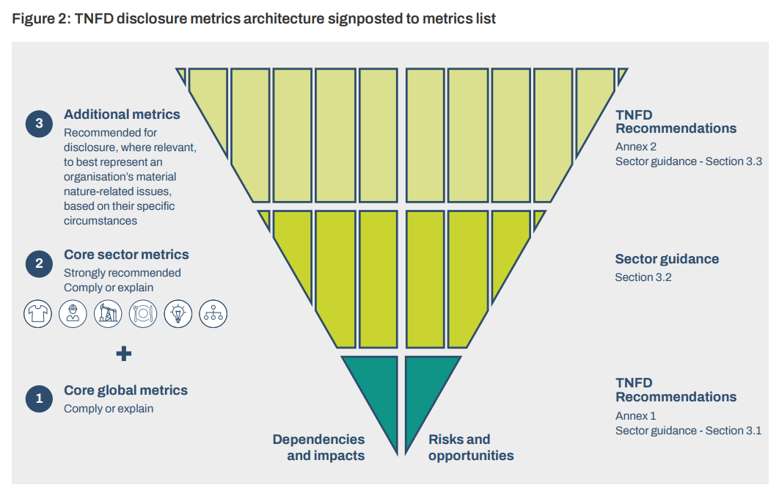
(Source: Taskforce on Nature-related Financial Disclosures Additional sector guidance - Alternative fuels, June 2026)
TNFD's guidance signals that "nature" is no longer a peripheral consideration in the transition to alternative fuels. Irrespective of its position in the value chain, organisations now face a defined expectation to disclose how their fuel pathways interact with land, freshwater, biodiversity, and other environmental assets where they are preparing voluntary sustainability disclosures. Decarbonisation credentials alone will not insulate organisations from nature-related scrutiny.
Legal updates and articles on the topics that matter to you, sent as they happen.
Subscribe